
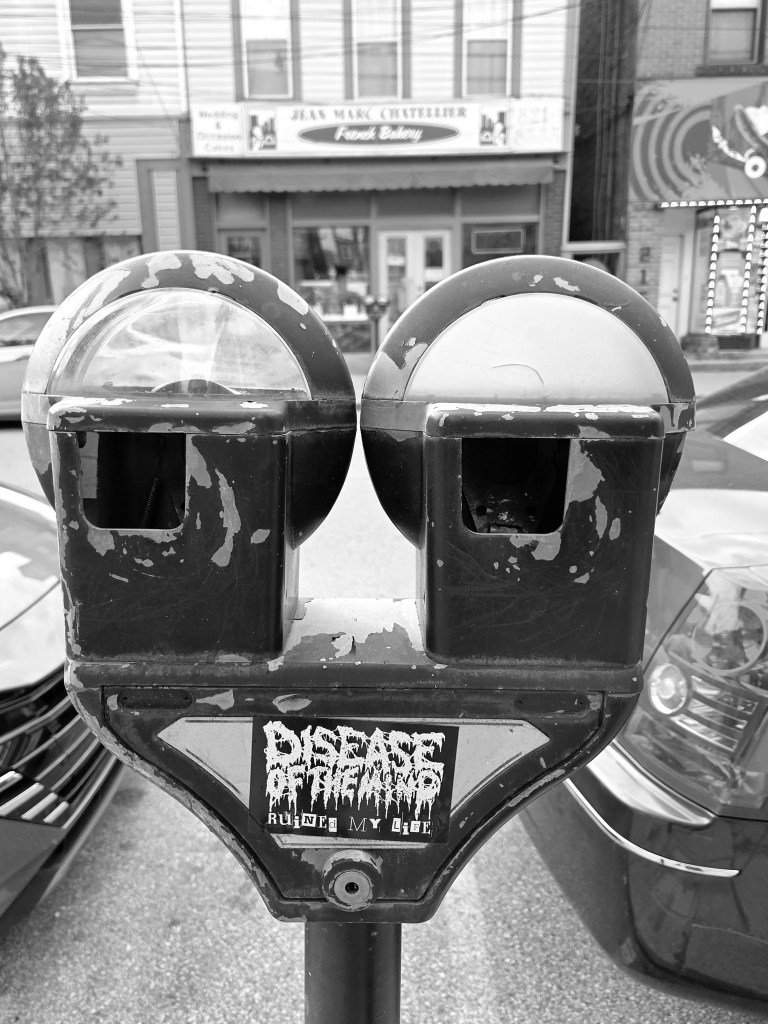
I’m in Millvale. I had delicately parked next to one of a scant handful of meters, but as I circle around, fumbling for change, I discover two empty metal husks. The ex-meters grin vacantly at me like the desiccated shell of a desert toad. Somebody had slapped a sticker over where its mouth should be. It read DISEASE OF THE MIND RUINED MY LIFE. So…free parking?
The Millvale neighborhood is on the north side of the Alleghany River. It’s gritty. Sidewalks crushed to chalk. Husks of store fronts matching the husks of parking meters. A few hipsters dart through the dusk, avoiding eye contact and disappearing into nondescript rowhouses. I’m standing in middle of Lincoln Street and North Avenue. I’m not looking out for traffic, and to passing drivers, I must look like a confused amnesiac. The only thing missing is an oversized white bandage around my forehead. I’m trying to find 233 North Ave, one of the first residences of Emmanuel and Sophia Wertheimer, and I’ve encountered a problem. There is no 233 North Ave. There is just road. In between Custom Hair Studio (227 North Ave) and Tasty Taquitos (301 North Ave) is… Lincoln Street?
***
There are ghosts of buildings everywhere. I’m scribbling in my sketchbook at a rooftop bar in downtown Pittsburgh, and when I look up, I’m staring at an enormous twelve-story edifice across the street. The wall has no windows, no adornment. Just a massive field of brick. In the raking yellow-orange sun of happy hour, easily visible if not legible, are painted letters, chipped and faded, advertising some long forgotten ghost business. Earlier that day, walking down Penn Avenue, on my way to the Heinz History Center, I spotted the ghost of a building on the side of its neighboring wall. More brick. I paused to let my eyes travel along the delineations of each story and up the diagonal bands of missing staircases. Here there was layer upon layer of paint, and I could almost make out the smudges of children’s dirty fingers as they trudged up to their fourth-floor walkup. Ghosts in grime.
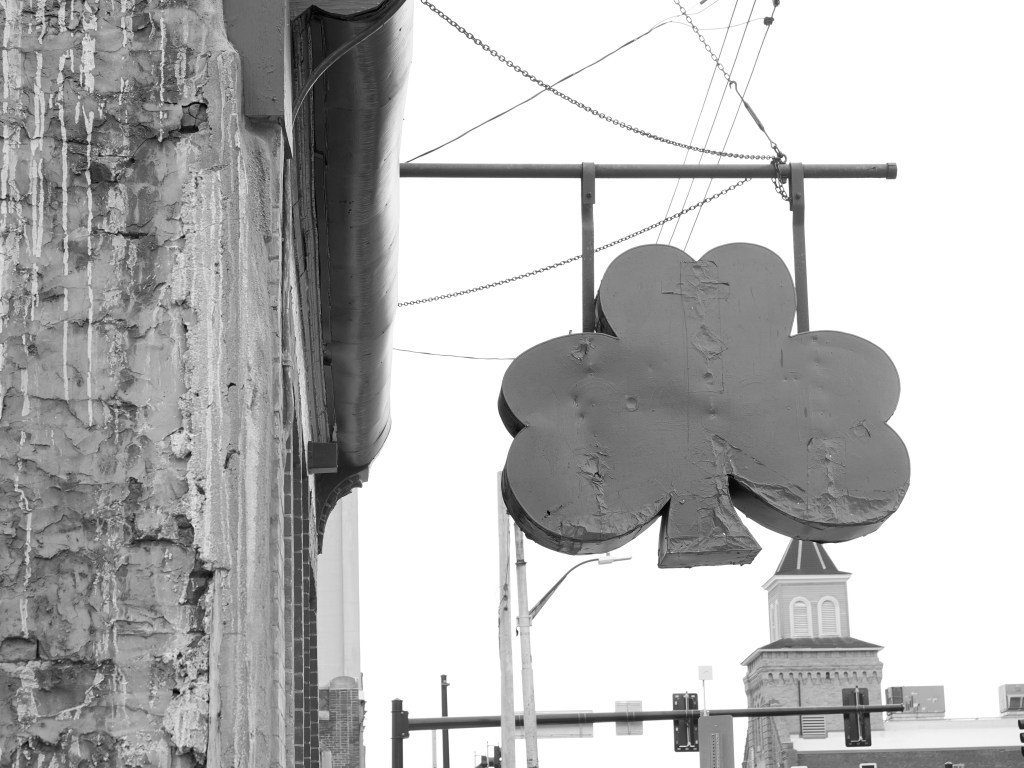
But this particular building, with all that history tattooed onto its flank, had somehow avoided the wrecking ball. The demolition crane now parked, lay like a sleeping bird in the lot next door. How was this skinny edifice spared? A dank wind of stale beer and cigarettes greeted me like a drunk uncle as I walked around to the front. A boxy metal sign cut into the shape of a shamrock and painted green hung above a bar, closed and dark. A couple of heavies lugged kegs out of a truck and rolled them into a hole in the ground. After closer inspection, I saw the cold gray neon tubes in the front window: LUCKY’S.
***
You expect stones to last forever. You expect bricks to stand through centuries, through generations, through presidential campaigns, through the wettest winter in history, through the hottest July in record, through recessions and the subsequent downtown revitalization. But I’m from the East coast. I lived in New York City long enough. I should know better.
I’m pacing up and down North Ave. West North Ave. I think I’m onto something now. In the late nineteenth century, many of the German Jewish families in Pittsburgh moved across the Alleghany River to join the wealthy families and keep the rapidly growing downtown at an easy commuting distance. I’m in North Shore, which is closer to downtown than Millvale. It makes sense. This neighborhood is posh as fuck. No husks here. The ubiquitous Pittsburgh brick Victorian row houses have been meticulously restored, rejuvenated, resurrected from the dead. Well-coiffed hanging plants and American flags bracket doors painted sky blue and fire-engine red. Across the street, in Alleghany Commons Park, a statue of George Washington perches on horseback. Maybe he can point out number 233. He stares past me, face slack in weary, resignation as a sizable flock of Canada Geese decorates the grass with curls of gray-green shit. No help from George.
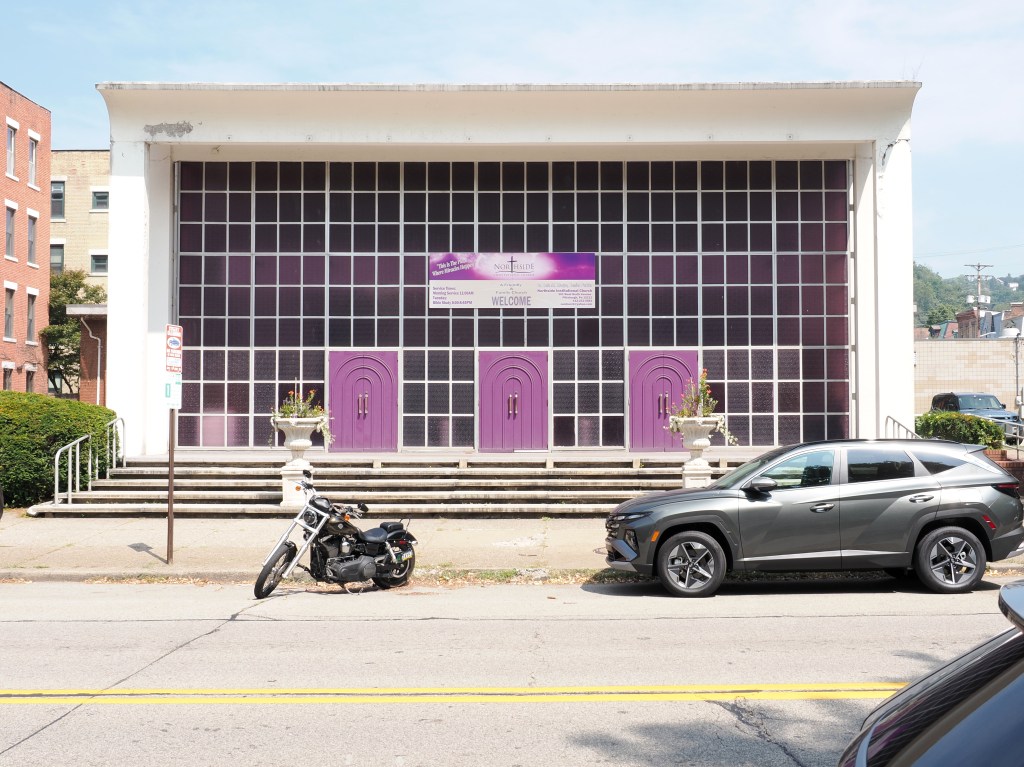
Google Maps is no help either, as the addresses rarely match with the numbers on the door. After a good deal of pacing, peering and Googling, I surmise that 233 W. North Ave is now the lawn next to the Northside Institutional Church. Judging from the clean lines and poured concrete, this building was built sometime between 1950 and 1970. The south side of the church, facing the park and the street, is a wall of 225 panes of purple glass (I counted), each about twelve by eighteen inches, but just to make sure you didn’t miss the point: purple glass! Three sets of purple doors with gold handles lead into the sanctuary. I feel like I’ve stepped into a riddle. One where when I’m about to give up, Ram Das will gently swing open the middle door and beckon me inside. Maybe Ram Das knows where 233 North Ave is.
Why is it so hard to find historic homes? And why is this so important to me? Where does this need come from, to walk up, to physically touch the past? I want to pin it down, to embody it, to take it into my being like a souvenir. Is what I’m feeling the same urge that tourists get in National Parks? Am I no different than those yahoos who roll down the window and try to pet a grizzly bear or a moose? Does the fact that I’m writing about it, making art about it, justify my need to drag a finger across its façade? Yes. Yes it does. I need to touch an old building.
 Porter McDonald